Prepare for your flight
Everything you need, in one place.
What to bring, where to meet, what to expect, a short safety video, and the waivers you'll sign before you show up. Give this page ten minutes before your flight date.
What to bring, where to meet, what to expect, a short safety video, and the waivers you'll sign before you show up. Give this page ten minutes before your flight date.
This video walks through everything you'll see on launch day — the equipment, the safety briefing, what the run on launch looks like, and what landing feels like. It has a few quirks and a fun accent (it's not mine — I'll be filming a Topping Out version in time), but it covers the essentials cleanly and watching it beforehand means we spend less time on the ground and more time in the air.
 ▶ Watch on YouTube
Tandem Paragliding Instructional Video — Safety Guidelines by Parabooking.com.
Once we're airborne, the wind-chill makes it feel roughly 10–15°C cooler than on the ground, and it drops noticeably more as we climb. Err toward layers.
I review the 7 PM weather update and text you with the go/no-go call and a meeting time the evening before. If anything shifts overnight, I'll follow up in the morning. If the forecast is marginal, I'll let you know we're on standby.
We meet at or near the landing zone. Before heading up, we verify your waivers are complete and received, and make sure you've got appropriate footwear and a few extra layers of clothing. I bring all the flying gear, including helmets. From there we drive up the gravel forest service road to launch — 15–25 minutes depending on the site.
On launch, I'll walk you through the things you need to know, and I'm happy to talk through setting up the gear and preparing for flight. We'll get you into the harness and run a few practice pulls so you know what to expect. Then we clip in to the glider, wait for the right wind cycle, pull the wing up, and run into the air.
Anywhere from 7 to 30 minutes of airtime, depending on conditions. Smooth straight-line flight by default; I'll ask if you want gentle turns. If conditions are thermic I can show you what climbing in lift feels like and we'll stay up longer.
We land at a designated landing field on the valley floor. As we come in, I'll ask you to keep your legs raised, and we'll approach prepared to land on the inflated seat. Keep your legs up until I tell you to stand.
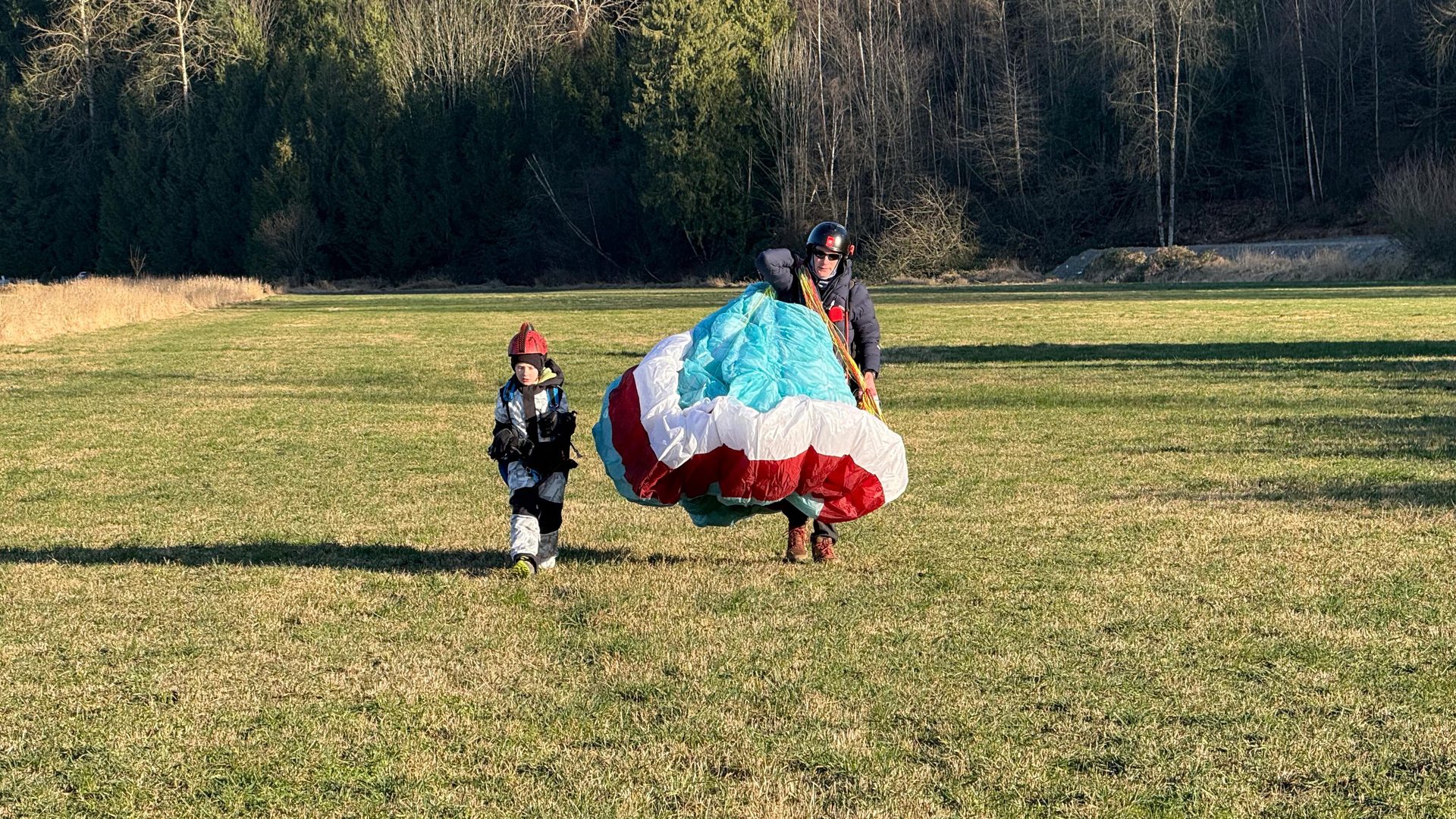
Packing up the glider takes about 10 minutes, after which we head back to the vehicles — either right next to the landing field, or a short walk or drive away.
Which site we fly depends on the day's conditions and the kind of experience you want. I'll confirm your meeting point in your pre-flight message — these are the three possibilities.
Meeting point is the Woodside Inn coffee shop parking lot (left side) at 2226 Lougheed Hwy, Agassiz, BC. About 5 minutes past the Sasquatch Inn / Hemlock exit if you're coming from Mission on Hwy 7.
One of the Lower Mainland's premier flying sites, maintained by the West Coast Soaring Club. The launch is a ~15-minute drive up a 4×4 logging road from the meeting point — I shuttle us up. Panoramic views over the Fraser Valley and Harrison River. Landing is in the designated field at the base of the mountain, just north of Hwy 7.
Meeting point is the paraglider landing zone — the large mowed field east of the Bridal Falls Golf Course driving range, not the launch. About 100 km / 60 mi east of Vancouver, between Chilliwack and Hope on the Trans-Canada. The launch is a 4×4 drive up the mountain from here — I handle that side of the logistics.
Typically an afternoon and evening site, flyable most summer days once thermal activity picks up; best season is early April through fall. Airspace falls under CYA 105 (H) up to 8,000 ft ASL — glider planes work the same mountains, so we fly with heads up.
Site maintained by the West Coast Soaring Club, who hold the tenures on both launches and the LZ.
Open in Google MapsElk is the hike-and-fly option — a very different experience from Woodside and Bridal. We meet at the landing zone on Prest Road, usually first thing in the morning. From there we shuttle up Elk View Forest Service Road to the upper trailhead (not the main lower one — starting from up here saves about 30 minutes of hiking) and head up together. Expect about an hour on the trail with 600 m of elevation gain. I split the tandem kit into two roughly equal packs — about 20 lb each — and the passenger carries one of them.
Because of the pack and the climb, Elk is only recommended for able-bodied, reasonably fit people who are somewhat used to hiking. If that's not you, Woodside and Bridal are the better call — both are drive-up launches.
The reward for the hard work of hiking up the mountain is big views of the Chilliwack River Valley peaks and Mt. Baker to the south — and then a flight down that saves your knees on the descent. The air at that hour is typically glass-smooth with no thermal activity, so the flight itself is short: around 15 minutes top to bottom. On the occasional lucky day with enough south wind, we get a proper ridge-soaring session and can stay up much longer — but that's only about 5% of flights here.
Paragliding has real risks — that's why we require waivers. What I can tell you: tandem flight is the lowest-risk form of the sport. A tandem wing is nearly twice the size of a solo wing, and with the combined weight of pilot and passenger loading it up, the result is a noticeably more stable aircraft than a solo setup. Beyond that, I'm flying with you — I won't launch into any situation where I don't feel it's safe to do so — and we fly under HPAC's national safety framework. Please read the waiver forms in their entirety, and if you don't feel the risk is worth taking, don't book.
Most people find paragliding is different from being on a tall building or in a glass elevator. You're not looking down a sheer drop — you're sitting in a comfortable harness, floating. The sense of height is more "big sky above and around you" than "I could fall." That said, if genuine height anxiety is a thing for you, tell me and we'll talk through it before launch.
It can happen on turny or thermic days. If you're prone to car or sea sickness, take a Gravol an hour before meeting me — and tell me, so I can limit the turns and turbulence and keep the flight relatively short, so you can enjoy the experience fully.
Yes, but it needs to be on a secured strap or tether — not just held in your hand. A dropped phone from 2,000 feet is dangerous for whoever's underneath. I'll show you how to secure it before we launch.
We reschedule at no cost, as many times as it takes. Your payment stays with me until you've actually flown.
For a specific date, two to three weeks ahead is comfortable. For flexibility on when you fly, a few days is plenty.
Every participant must sign three waivers before launch: a personal release naming Leonard Kerkhoff as pilot of record, the HPAC national standard release, and the West Coast Soaring Club's site waiver (WCSC maintains both Woodside and Bridal). All three are signed in a single flow — digital, five to ten minutes.
A personal release naming Leonard Kerkhoff as the pilot in command of your flight. Mirrors the HPAC release's framework, with scope specific to this operation.
The Hang Gliding and Paragliding Association of Canada's national release, waiver, indemnity, and assumption-of-risk agreement — identical to the one used by every HPAC school and tandem operator in the country.
The West Coast Soaring Club's visitor release, required at both Woodside and Bridal Falls — the Fraser Valley sites they maintain and hold tenures on. Also used by every other operator flying their sites.
You'll receive signed PDF copies of all three by email once submitted, and I'll receive my own copies for the file.
Haven't booked a flight yet? Pick a date →